How to Use The Chunking Method to Speak French Fluently
For years, I'd freeze in French conversations. I knew the words, but building a sentence from scratch, word by word, while someone stood waiting for an answer just wasn't possible without hesitation, panicking and making mistakes. The problem wasn't necessarily my vocabulary or grammar. It was that I was starting from zero every time I opened my mouth, trying to construct an entire sentence in my head before saying anything out loud.
What made a difference was learning French in chunks: groups of words I could reach for automatically, rather than trying to remember individual words and assemble them under pressure. Once I'd practised the phrases I actually needed in everyday situations, they started coming out almost fluently, without much thought. That gave me more time to think about what I wanted to say next, rather than getting stuck on the first few words.
What is the chunking method, and why does it work for speaking French?
Chunking means learning groups of words as a single unit rather than memorising individual words and trying to piece them together every time you speak. These might be complete expressions, common word combinations or sentence starters you can finish in different ways. Linguists call some of these lexicalised sentence stems: familiar sentence openings that you can retrieve automatically rather than constructing word by word.
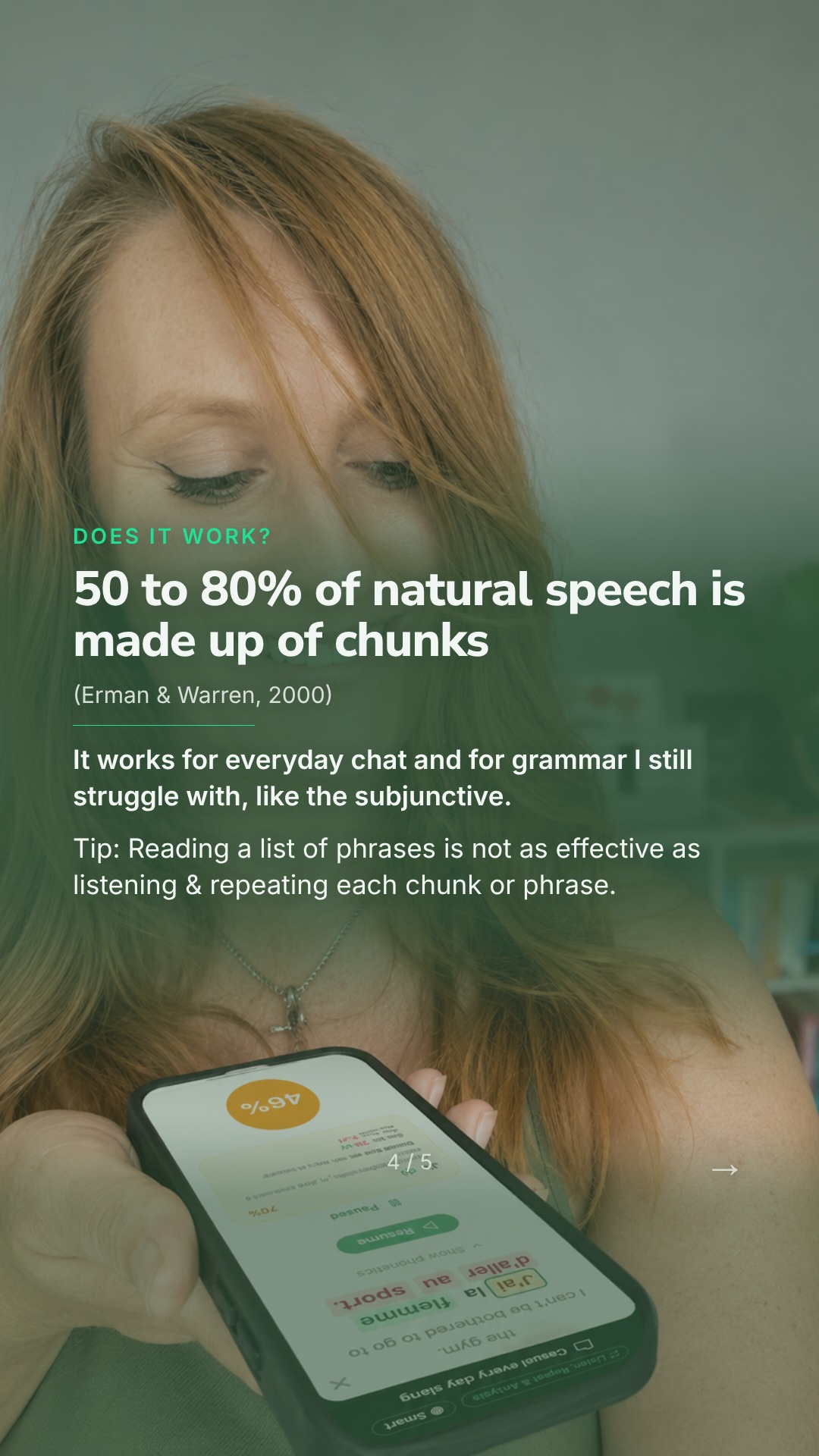
There's research behind the approach too. Studies by Pawley and Syder (1983) and Erman and Warren (2000) highlight how much of natural language relies on familiar, memorised word combinations. Research by Boers and colleagues (2006) also found that learning through chunks can improve spoken fluency.
It certainly reflects my experience. The French phrases I can say without hesitation the ones I've repeated hundreds of times. The ones I stumble over are usually the ones I've only ever read in a textbook. This method is certainly a great way to learn french without the overwhelm.
What does a French chunk actually look like?
For me, the most useful chunks are often sentence starters. They're helpful because getting the first few words out is usually the hardest part. Once you've started, it's much easier to keep going.
Here are a few examples I use:
- - "Je voulais savoir si..." (I wanted to know if...) Useful for asking questions or making enquiries without sounding too direct.
- - "Est-ce que je peux...?" (Can I...?), for asking permission or if something's possible.
- - "Le problème, c'est que... "(The problem is that...)
- - "Je pensais que..." (I thought that...)
- - "Ce que je veux dire, c'est que..." (What I mean is that...)
- - "Ça dépend de..." (It depends on...)
- - "Je ne sais pas si..." (I don't know if...)
Practise saying the entire expressions over and over again until they comes out naturally. Then experiment with different ways to finish the sentence. You're not memorising hundreds of complete sentences. You're learning reusable building blocks that you can adapt to different situations.
Chunks aren't just for beginners
One of the things I find great about this approach is that it doesn't stop being useful as your French improves. In fact, I think chunks become even more valuable when you start tackling more complicated grammar.
Take the subjunctive or the conditional, for example. It's something I still struggle with. I understand the rules reasonably well, but trying to remember which situations require it, select the right verb form and construct the sentence while having an actual conversation is a different challenge. Rather than trying to remember a complicated grammar rule every time I speak, I'd much rather have a collection of commonly used expressions already committed to memory. This is actually how I prepared for my DELF B2 exam!
For example:
- - "Il faut que je fasse..." (I have to do...)
- - "Je ne pense pas que ce soit..." (I don't think that it's...)
- - "Je suis contente que tu aies..." (I'm pleased that you have...)
- - "Je préférerais que..." (I would prefer that...)
If you practise these expressions as complete chunks, you're also practising the grammar that goes with them. You don't have to mentally work through the rules every time you want to use them.
Of course, understanding the grammar still matters, particularly as you progress. But having frequently used structures ready to go makes it much easier to use that grammar in real conversations.
Don't forget the little French "fillers" that keep conversations going!
Not every useful chunk needs to be the beginning of a complicated sentence. Some of the most useful expressions are the little fillers that give you breathing space when you're thinking. French speakers use these constantly, and learning to use them yourself can make conversations feel much more natural.
A few worth practising:
- - "En fait..." (Actually...)
- - "C'est-à-dire..." (That is to say...)
- - "Comment dire..." (How can I put it...)
- - "Ce que je veux dire, c'est que..." (What I mean is that...)
- - "Du coup... "(So / as a result...)
They're not just fillers. They help you maintain the flow of a conversation while you work out what you want to say next and if you're anything like me, having a few seconds to organise your thoughts without looking completely lost is a definite advantage!
How I practise French chunks with Mimique
Knowing about chunks is one thing. Being able to actually say them naturally is another. Simply reading a list of expressions isn't going to make them roll off your tongue. I used to keep a notebook full of phrases and chunks I wanted to learn from my various french lessons, applications and daily life, however, they never stuck. You need to hear them, repeat them and practise saying them out loud until they become familiar. Not read a list in a notebook now and again!
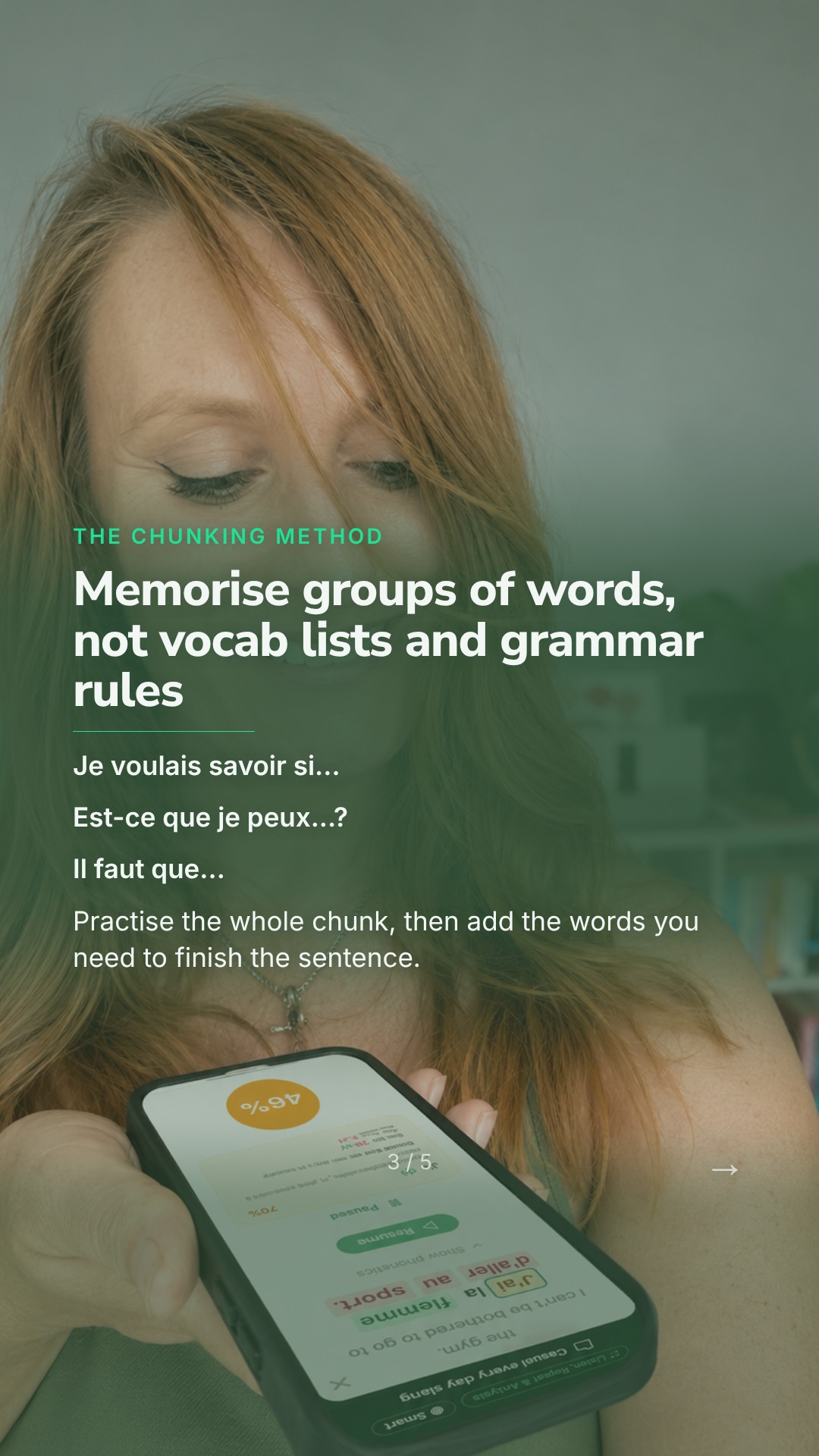
That's exactly the approach I've built Mimique around. You can add your own phrase, listen to a natural French voice, repeat it and listen to a recording of yourself. Mimique then gives you pronunciation feedback so you can see which sounds need more work.
Listening back to recordings of yourself speaking French isn't necessarily the most enjoyable experience (I still haven't got used to that part!), but it's a much better way of spotting pronunciation problems than simply hoping you've got it right.
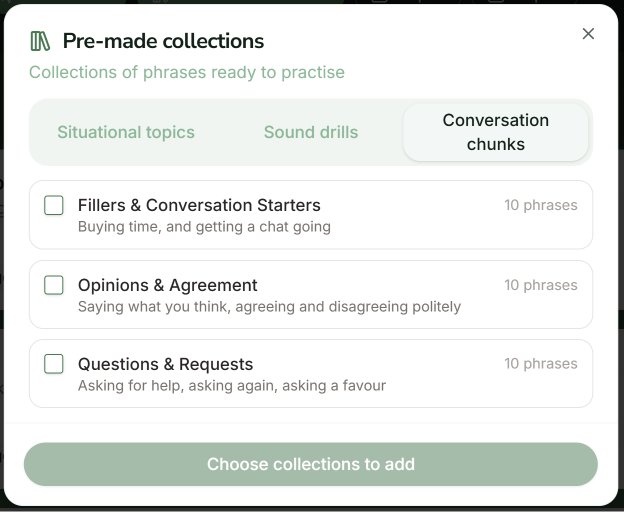
You can practise individual phrases, build your own collections of useful chunks or use the ready-made collections in the app to get started.
The idea is simple: practise the French you actually want and need to say, by listening and repeating, until you no longer have to think quite so about the words you are saying.
You can try practicing French chunks & phrases for free at mimique.app.
Questions people ask
What is the chunking method in language learning?
It means learning and practising a group of words as one single piece, rather than assembling them word by word on the spot. That can be a whole phrase, a fixed word pairing, or the start of a sentence, which is the type that's helped me most. Linguists have pointed to chunking for decades: a widely cited 1983 study described these memorised phrases as the main building blocks of fluent speech, and later research estimates that somewhere between half and most of everyday speech is made up of chunks like this rather than sentences built fresh each time.
What is an example of a chunk in French?
A chunk can be any group of words learned as one unit, from a verb pairing like "poser une question" to a whole set phrase. The ones that help most when you freeze mid-sentence are usually the start of a sentence: "Je voudrais..." (I'd like...), "Est-ce que je peux...?" (Can I...?) and "Il faut que..." (I need to...) are all chunks like this. Learn the shape once, and you can finish it with whatever words the moment needs. Mimique has ready-made chunk collections if you want a starting point rather than building your own list from scratch.
Is learning chunks better than studying grammar?
Not better, just different, and research suggests they work best together. A review of teaching methods found learners taught with chunks ended up more fluent than those taught the same material word by word, but chunk-based learning is generally seen as something that complements grammar study, not a replacement for it.
How many French phrases do you need to be conversational?
There's no fixed number, and chasing one is part of why vocab lists don't help much. What matters more is how often you've actually said a phrase out loud. A handful of chunks you've practised until they're automatic will get you further in a real conversation than hundreds you've only read.
Is there an app to practise saying French chunks out loud?
Yes, that's what Mimique is for. You add the chunk or phrase you want to practise, hear it said by a native voice, and Mimique records you saying it and gives you pronunciation feedback on what to fix.