How to Improve Your French Pronunciation: 5 Things That Actually Work
If I could go back and tell myself one thing when I started learning French, it would be: prioritise your pronunciation, right from the start!
I didn't, and I'm still paying for it now. I prioritised learning grammar, doing the exams and following the process we're all told to follow. However, I'm still not fluent and my pronunciation still isn't where I want it to be.
That's honestly the whole reason why I built Mimique. Not because I've cracked it and I'm here to share the secret, but because I spent years putting time into grammar rules and vocabulary lists, assuming pronunciation would sort itself out along the way. It didn't.
Years later, I'm still dealing with misunderstandings and frustrations rather than having the confident conversations I'd like. And a lot of that comes down to how I'm saying the words, not whether I know the grammar behind them.
Whether you're just starting to learn French or have spent years studying but still struggle to speak confidently, this is the one piece of advice I'd actually stand behind: prioritise your pronunciation, or at least give it equal weight to everything else, from day one.
Why French pronunciation is so often overlooked (and why it's hard for English speakers)
It's not just you, and it's not just self-taught learners. Pronunciation correction is something even formal French teaching (FLE, French as a foreign language) tends to skim over, compared to the time spent on grammar and vocabulary.
Classes are often built around what you can read, write and conjugate, because that's what's easiest to teach and test. On top of that, French uses sounds and a rhythm that English simply doesn't have. So it's not necessarily a lack of effort. It's a skills gap that nobody has properly taught you how to address.
Most of us leave lessons knowing a lot of French but being able to say very little of it clearly.
5 French pronunciation tips that actually work
These are five things that have made a difference to my own pronunciation practice, in order of how much they've helped. I'll also explain how Mimique helps you put each one into practice.
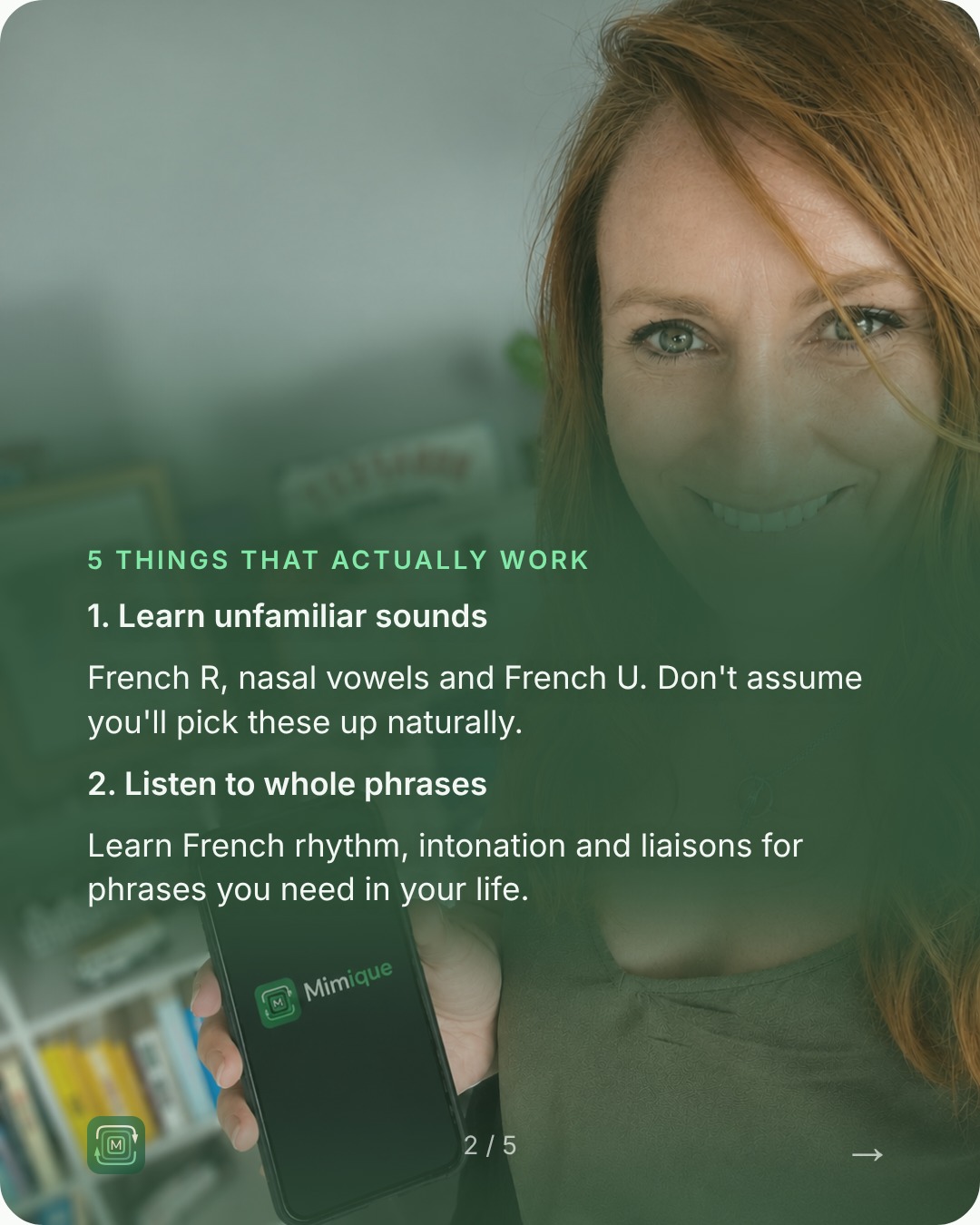
1. Learn the French sounds that don't exist in your own language first.
English doesn't have the French R, French nasal vowels or the French U, so your mouth has never had to make these shapes before. Trying to learn them buried inside long sentences is much harder than isolating them first.
I've written about the specific sounds that trip English speakers up most in French Sounds That Don't Exist in English, so I won't repeat all of that here.
The important thing is to practise phrases that contain the particular sounds you're struggling with, rather than just practising random vocabulary.
Mimique can help you identify the sounds you struggle with and give specific lessons and drills to improve those sounds, words and then give you phrases including tongue twisters (virelangues in French) which are a genuinely good, slightly silly way to stress-test it. Or you can add your own custom phrases that you want to master and get feedback on them too.
2. Learn French rhythm by listening to whole phrases, not individual words.
English stresses certain syllables in a word more than others. French doesn't work in quite the same way. Its rhythm is more even, with intonation and pitch patterns that are different from English.
The same goes for liaison, where a word's final consonant links onto the vowel starting the next word (les amis sounds like "lèz-amis", rather than two completely separate words).
My advice is to listen to a whole phrase in a native French voice, repeatedly, before trying to say it yourself. Give your ear time to recognise the rhythm, sounds and flow of the sentence first.
This is exactly why Mimique works with complete phrases and natural French voices rather than isolated words. It also includes a ready-made collection of common French chunks, the sentence starters you'll actually use in everyday conversations, as well as letting you add your own phrases.
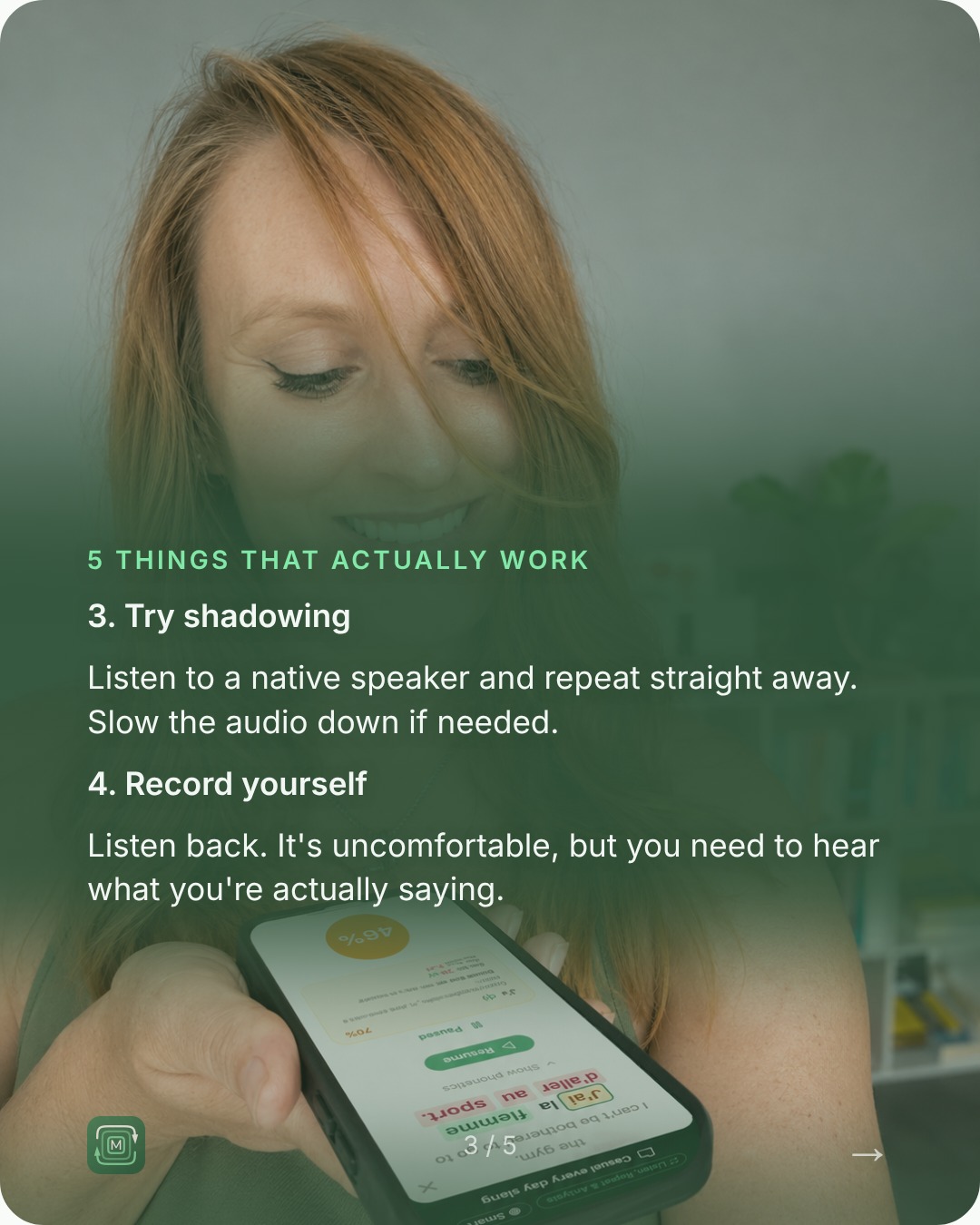
3. Practise French shadowing: listen, then repeat straight away.
Shadowing, listening to a native speaker and repeating what they say, is one of the techniques supported by research for improving pronunciation and speaking skills.
I've written a full post about it here: Shadowing Technique for French.
If you're starting too fast, you're just mimicking a blur rather than actually producing the sounds. That's why slowing the audio down first is worth doing.
Mimique includes adjustable audio speed, so you can slow phrases down while you're learning them before gradually building up to normal speaking speed.
But the main point is the repetition: hearing the phrase and then saying it out loud, not just listening passively.
4. Record yourself speaking French and actually listen back.
This is the step most people skip because it's genuinely uncomfortable.
Your recorded voice sounds different to you, mostly because of simple acoustics. When you speak, you hear yourself partly through bone conduction, whereas a recording only picks up sound travelling through the air. That's why listening to your recorded voice can be a bit disturbing!
But you cannot fix what you can't hear so listening back is one of the best ways to close the gap between what you think you said and what actually came out.
Mimique builds this step into the practice process rather than leaving you to remember to do it. You have the choice to manually or automatically record you saying each phrase, so you can listen back and compare your pronunciation with the original French audio.
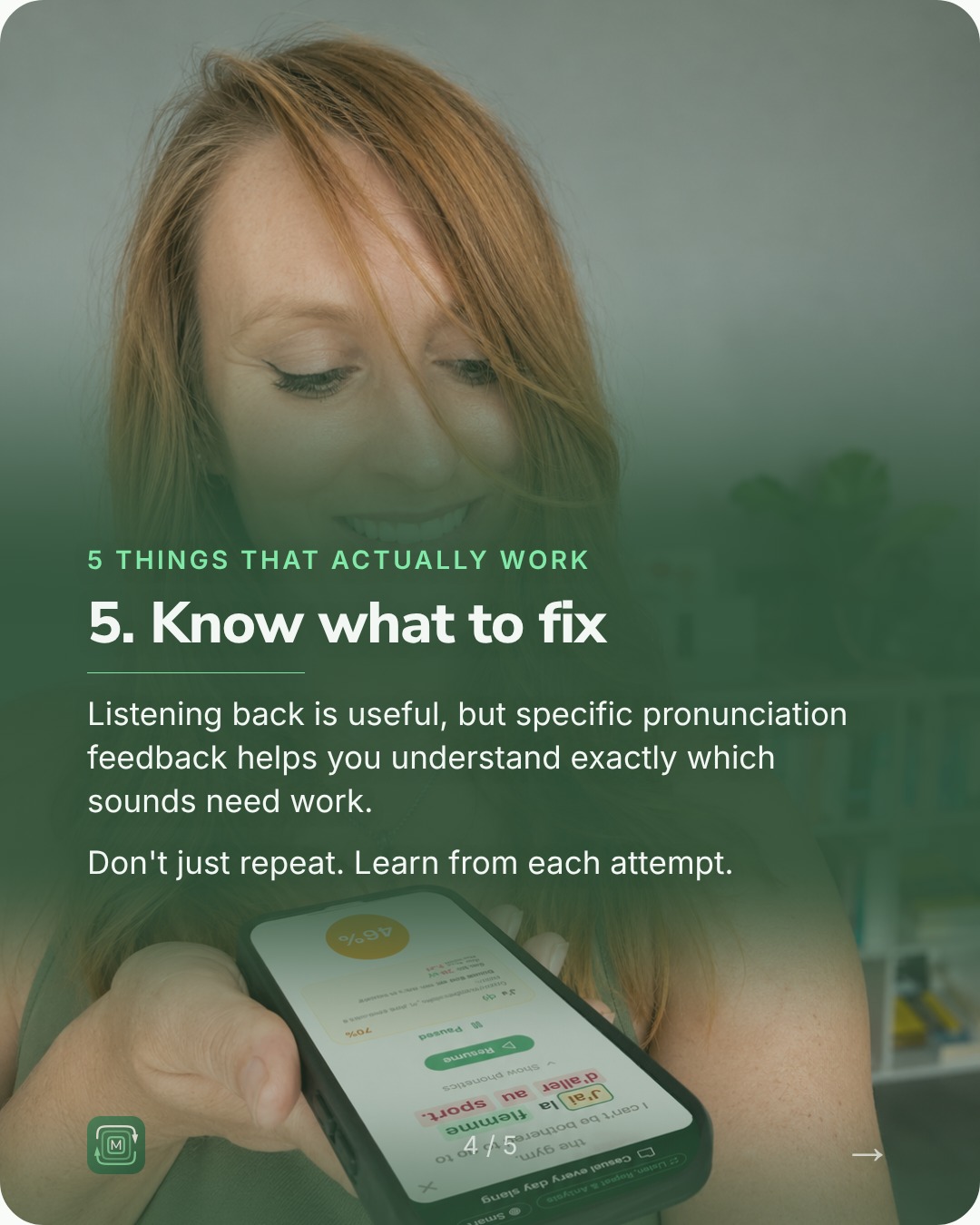
5. Get specific feedback on your French pronunciation.
Listening back tells you when something sounds off. It doesn't always tell you exactly what went wrong or, more importantly, how to fix it. This is a big part of Mimique.
After recording your phrase, Mimique analyses your pronunciation, scores how accurately you've spoken and gives you specific feedback on the sounds and words that need attention.
Instead of being left with a vague feeling that something didn't sound right, you have something concrete to work on next time.
That's the step that closes the loop: listen, repeat, record, get feedback and try again.
How to Make French Pronunciation Practice a Daily Habit
None of this works particularly well as one long practice session either. Cramming pronunciation practice in isn't nearly as effective as spreading it out over several days. I've written about why in Why 5 Minutes of French Practice a Day Actually Works.
A few minutes a day, working on these five things with phrases you'll actually use rather than a generic vocabulary list, is what's making a difference for me. It's not one particular trick on its own, but putting all these steps together and practising consistently.
If you only take one thing from this post, make it the thing I wish someone had told me years ago: don't leave pronunciation until later.
Want to start working on your French pronunciation?
Mimique brings all five steps together in one place. Listen to natural French voices, practise real-life phrases, slow down the audio, record yourself and get AI-powered pronunciation feedback to help you understand exactly what to work on.
You don't need to be fluent or confident to get started. You just need a few minutes a day.
Questions people ask
How can I improve my French pronunciation?
Work on the specific sounds that don't exist in your own language, listen to whole phrases in a native voice before you try to say them, shadow by repeating straight after you hear them, then record yourself so you can hear the gap between what you think you said and what came out. Pronunciation feedback, a score plus specific tips on what to fix, is what actually closes that gap. That loop is what Mimique is built around.
Can adults improve their French accent with practice?
Yes. Sounding completely native gets harder the older you start, but being clearly understood is a different, much more achievable goal, and it responds well to regular speaking practice. Most of the improvement people notice comes from consistent practice on the sounds and rhythm that trip them up, not from age.
How long does it take to improve your French pronunciation?
You can hear a real difference within a few weeks of regular practice on specific sounds, though it depends how far off you're starting from and how consistently you practise. Pronunciation responds faster than grammar does, mainly because it's physical: it's about training your mouth, not memorising more rules.
Why is French pronunciation so hard for English speakers?
Mostly because French uses sounds English doesn't have (nasal vowels, the French R, the u), and because French rhythm and intonation work completely differently to English, which most classes don't spend much time on. It's a skills gap, not a sign you're bad at languages.
Is there an app that helps with French pronunciation?
Yes, Mimique is one. You add the French phrases you actually need, hear them in a native voice, and it records you saying them and gives you pronunciation feedback, with a score and tips on the sounds to work on. You can try it for free at mimique.app.